









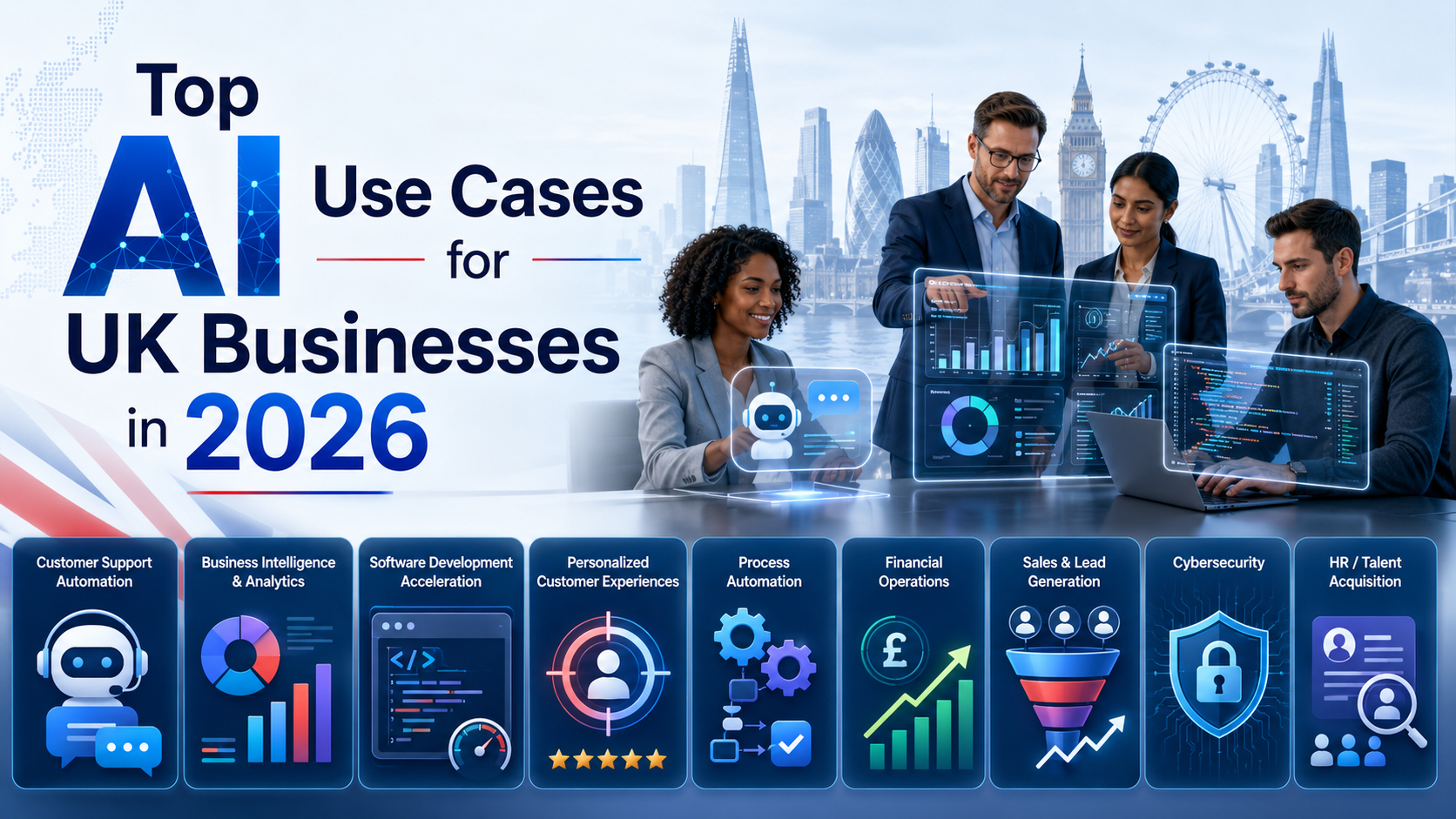
Artificial intelligence is no longer an emerging technology reserved for large enterprises. In 2026, businesses across the United Kingdom are actively integrating AI into their operations to improve productivity, reduce costs, and gain a competitive edge. From startups in London to established firms across finance, healthcare, retail, and professional services, AI is transforming how organizations operate and deliver value.
As adoption continues to accelerate, business leaders are shifting their focus from experimentation to implementation. The question is no longer whether companies should use AI, but where they can generate the greatest return on investment.
Customer Support Automation
One of the most widely adopted AI applications is customer support automation. Modern AI-powered assistants can handle common inquiries, route requests to the appropriate departments, and provide 24/7 support without increasing operational costs.
Businesses that previously relied on large support teams are now using conversational AI to improve response times and customer satisfaction. These systems can answer questions, retrieve account information, schedule appointments, and even assist with troubleshooting.
The result is a more scalable support model that allows human agents to focus on complex and high-value interactions.
AI-Powered Business Intelligence
Organizations generate massive amounts of data every day, yet many struggle to convert that information into actionable insights.
AI-powered analytics platforms are helping companies identify trends, forecast demand, analyze customer behavior, and uncover operational inefficiencies. Rather than spending hours manually reviewing reports, decision-makers can leverage AI to receive real-time recommendations and predictive insights.
This capability is particularly valuable in sectors such as retail, logistics, and financial services, where data-driven decisions directly impact profitability.
Software Development Acceleration
AI is dramatically changing the way software is built.
Development teams are using AI tools to generate code suggestions, automate testing, identify bugs, and streamline documentation. These capabilities reduce development timelines and allow teams to focus on architecture, innovation, and product strategy.
Many organizations are partnering with experienced technology firms such as Withnocode to integrate AI into their development workflows while building scalable digital products that align with long-term business objectives.
Personalized Customer Experiences
Consumers increasingly expect personalized experiences when interacting with brands.
AI enables businesses to analyze user behavior, preferences, and historical interactions to deliver highly relevant recommendations and content. This level of personalization improves engagement, customer retention, and conversion rates.
Whether through e-commerce product recommendations, personalized marketing campaigns, or dynamic website experiences, AI helps businesses create stronger relationships with their customers.
Process Automation and Operational Efficiency
Repetitive administrative tasks continue to consume valuable employee time across many industries.
AI-powered automation solutions can process documents, manage workflows, extract information from forms, generate reports, and handle routine administrative functions. By reducing manual effort, organizations can improve efficiency while minimizing errors.
Companies implementing intelligent automation often report significant productivity gains within a relatively short period.
AI in Financial Operations
Finance teams are increasingly leveraging AI to improve forecasting, risk assessment, and fraud detection.
Advanced machine learning models can identify unusual transaction patterns, monitor compliance requirements, and generate more accurate financial projections. These capabilities allow businesses to make faster and more informed financial decisions.
For organizations operating in highly regulated environments, AI also helps strengthen governance and risk management processes.
Sales and Lead Generation
Sales teams are using AI to identify high-intent prospects, prioritize leads, and optimize outreach strategies.
By analyzing behavioral signals and historical customer data, AI systems can predict which prospects are most likely to convert. This allows sales professionals to focus their efforts on opportunities with the highest probability of success.
The result is improved sales efficiency and higher revenue generation without proportionally increasing headcount.
Cybersecurity Enhancement
As cyber threats become more sophisticated, businesses are turning to AI-driven security solutions to strengthen their defenses.
AI systems can continuously monitor networks, detect anomalies, identify suspicious activity, and respond to potential threats in real time. This proactive approach helps organizations reduce security risks and improve incident response capabilities.
For UK businesses handling sensitive customer and financial data, AI has become an increasingly important component of modern cybersecurity strategies.
Human Resources and Talent Acquisition
Recruitment and workforce management are also benefiting from AI innovation.
Organizations are using AI tools to screen candidates, analyze resumes, schedule interviews, and identify top talent more efficiently. Additionally, AI can assist with employee engagement, performance analysis, and workforce planning.
These capabilities help HR teams operate more strategically while reducing administrative workloads.
The Future of AI Adoption in the UK
Artificial intelligence is rapidly becoming a fundamental business capability rather than a competitive advantage reserved for early adopters. Companies that successfully implement AI are improving productivity, accelerating innovation, and creating better customer experiences.
As technology continues to evolve, UK businesses that embrace AI strategically will be better positioned to compete in increasingly digital markets. The most successful organizations will focus not only on adopting AI tools but also on integrating them into core business processes where they can generate measurable value and long-term growth.
Businesses that act now are likely to gain a significant advantage as AI becomes an essential component of modern operations across every industry.