







Plastic injection molding is one of the most widely used manufacturing processes for producing plastic components. It is used to manufacture everything from bottle caps, toys, and household products to automotive parts, electronic housings, medical devices, and precision industrial components.
The main advantage of injection molding is its ability to produce large quantities of complex parts quickly, accurately, and consistently. Although the initial cost of designing and manufacturing a mold can be high, the cost per part becomes very economical when production volumes increase.
What Is Plastic Injection Molding?
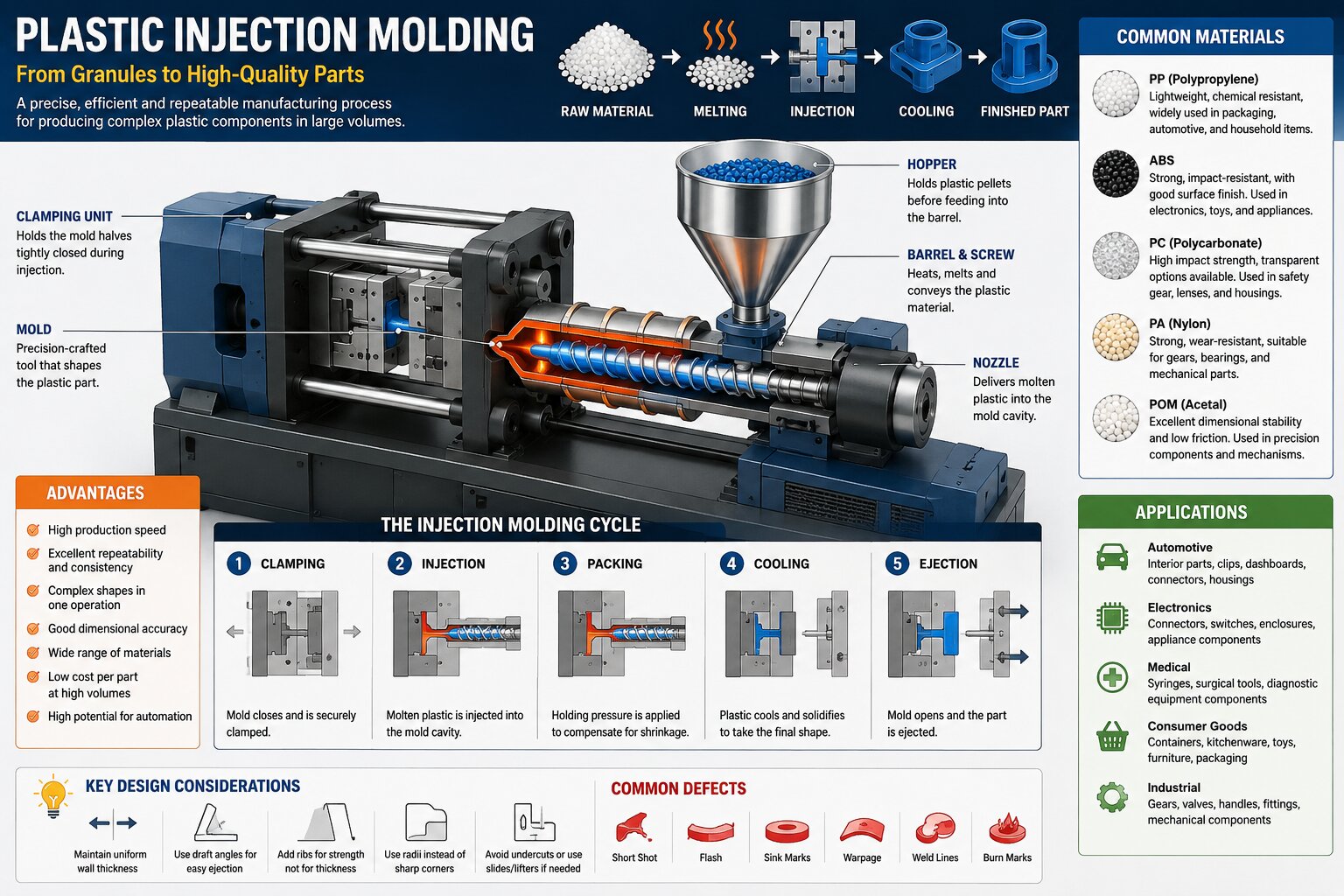
Plastic injection molding is a manufacturing process in which plastic material is melted and injected under pressure into a specially designed mold. The molten plastic fills the mold cavity and takes its shape. After cooling and solidifying, the mold opens and the finished product is ejected.
The basic process can be summarized as:
Plastic pellets → Melting → Injection → Packing → Cooling → Ejection → Finished product
Most injection molding processes use thermoplastics because these materials soften when heated and become solid again when cooled.
How Does Plastic Injection Molding Work?
The process begins by feeding plastic pellets into the hopper of an injection molding machine. The pellets enter a heated barrel containing a rotating screw. Heat from the barrel and mechanical action from the screw gradually melt the plastic.
Once enough molten material has accumulated, the screw moves forward and forces the plastic through a nozzle into the mold cavity.
The injection molding cycle generally consists of five main stages:
1. Clamping
The two halves of the mold close and are held together by the machine’s clamping unit. Strong clamping force is necessary because the plastic enters the mold under high pressure.
2. Injection
The molten plastic is injected into the mold. Injection pressure, speed, and temperature must be carefully controlled to ensure that the material completely fills the cavity.
3. Packing and Holding
After the cavity is filled, pressure is maintained briefly to compensate for plastic shrinkage during cooling. Proper holding pressure helps reduce defects such as sink marks and internal voids.
4. Cooling
Cooling channels inside the mold remove heat from the plastic. The component remains inside the mold until it becomes sufficiently solid to maintain its shape.
Cooling is particularly important because it often represents a significant portion of the total production cycle.
5. Ejection
After cooling, the mold opens and ejector pins or another ejection mechanism push the finished component out. The mold then closes and the next cycle begins.
Common Injection Molding Materials
A wide variety of plastics can be injection molded. Material selection depends on the required strength, flexibility, appearance, temperature resistance, chemical resistance, and cost.
Common materials include:
- Polypropylene (PP): Lightweight, economical, and chemically resistant. Common in packaging, automotive parts, and household products.
- Polyethylene (PE): Tough and chemically resistant; widely used for containers and consumer products.
- ABS: Strong, impact-resistant, and attractive in appearance. Frequently used for electronic housings, toys, and automotive components.
- Polycarbonate (PC): Known for excellent impact resistance and available in transparent grades.
- Nylon (PA): Strong and wear-resistant, making it suitable for gears and mechanical components.
- Acetal (POM): Provides good dimensional stability and low friction for precision mechanical parts.
Important Design Considerations
Good product design is essential for successful injection molding. One of the most important principles is maintaining uniform wall thickness. Large differences in thickness can cause uneven cooling, shrinkage, sink marks, and warpage.
Parts should also have suitable draft angles so they can be removed easily from the mold.
Ribs can increase structural strength without requiring excessively thick walls, while rounded corners can improve material flow and reduce stress concentrations.
Designers should minimize unnecessary undercuts, as they may require slides, lifters, or other special mold mechanisms that increase tooling complexity and cost.
Common Injection Molding Defects
Several defects can occur when product design, tooling, materials, or processing conditions are unsuitable.
Short shots occur when the plastic does not completely fill the mold cavity. Flash is excess plastic formed around the mold’s sealing surfaces. Sink marks are depressions caused by material shrinkage, especially around thick areas.
Warpage occurs when a component bends or changes shape because of uneven shrinkage or cooling. Weld lines can appear where separate flows of molten plastic meet, while burn marks may result from trapped gases or excessive heat.
Many defects can be prevented through proper mold design and careful control of temperature, pressure, injection speed, packing, and cooling.
Advantages of Plastic Injection Molding
Injection molding provides several important benefits:
- High production speed
- Excellent repeatability
- Ability to manufacture complex shapes
- Good dimensional accuracy
- Wide selection of plastic materials
- Low cost per part at high production volumes
- High potential for automation
- Ability to produce multi-cavity molds for increased productivity
- Minimal finishing requirements for many products
These advantages make injection molding especially attractive for mass production.
Limitations
The biggest disadvantage is the initial tooling investment. Designing and manufacturing a high-quality mold can be expensive and time-consuming.
Design changes can also become costly after the mold has been completed. For very small production quantities, processes such as 3D printing or CNC machining may therefore be more economical.
Applications
Plastic injection molding is used across almost every major manufacturing industry.
In the automotive industry, it produces dashboards, clips, housings, interior components, and connectors. Electronics manufacturers use it for switches, connectors, enclosures, and appliance components.
The medical industry uses injection molding for many precision plastic products, while consumer-goods manufacturers use it for containers, kitchen products, toys, furniture components, and packaging.
Future of Injection Molding
Injection molding is becoming increasingly automated and data-driven. Modern factories use robots for part handling, machine-vision systems for inspection, and sensors for monitoring production conditions.
Computer simulation can help engineers predict plastic flow, cooling, shrinkage, and warpage before manufacturing the mold. Manufacturers are also focusing on reducing energy consumption and material waste while increasing the use of recycled materials where technically appropriate.
Conclusion
Plastic injection molding is an essential modern manufacturing technology. By injecting molten plastic into precision molds, manufacturers can produce large quantities of complex components with excellent consistency and competitive unit costs.
Successful injection molding depends on much more than the machine itself. Material selection, product design, mold engineering, processing conditions, cooling, and quality control must work together.
As automation, simulation, advanced materials, and smart manufacturing technologies continue to develop, injection molding will remain an important method for producing high-quality plastic products efficiently and economically.